
Understanding Ring Sizing
How Ring Sizes Are Measured
Nobody notices ring size until it goes wrong. A mere fraction of a millimetre separates a comfortable fit from a frustrating squeeze. Ring sizing is all about the internal circumference, the space your finger actually occupies. Jewellers measure this using a ring sizer, a set of hardened metal bands, or a tapered mandrel engraved with graduations. The ring slides down until it catches, and the reading is taken at that precise point.
Different regions complicate matters! Here is how the common systems break down:
- US and Canada: numeric sizes with half sizes.
- UK, Australia, and South Africa: letter sizes from A to Z.
- Europe: a numeric scale based on direct circumference measurement.
A silver ring size 8 means little without knowing which system applies. In South Africa, letters dominate, so a local size 8 is not the same as an American one. For instance, a silver ring size 8 from a local jewellery store might not correspond to the size on an overseas website. The internal diameter in millimetres is the only reliable comparison across all sizing methods.
DIY Finger Measurement Techniques
No finger remains constant. Morning warmth, evening chill, even the weight of a day can swell or shrink the flesh. That is why measuring at home demands caution. A silver ring size 8 in a store may fit differently by nightfall.
To capture your true size, use a strip of paper or a length of string. Wrap it snugly around the base of the finger, then mark where the ends meet. Lay the strip flat and measure the millimetre length. This is your circumference.
- Measure three times, preferably at different hours.
- Take the largest reading as your baseline.
- Compare the circumference to a conversion chart.
That conversion chart remains your only reliable reference. Without it, you risk an ill-fitting purchase.
Ring Size Conversion Across Different Countries
Somewhere on a jeweller’s bench, a silver ring size 8 waits for its owner. The problem? That number has different meanings across borders. South Africa uses the British letter system, where sizes run from A to Z. The United States relies on whole numbers. Europe measures the inner circumference in millimetres. Japan follows a scale from 1 to 30.
This is why conversion matters. A US numerical 8 corresponds to a UK letter P and an EU circumference of 58.7 millimetres. Without a reliable chart, the identical size bought in Cape Town might not fit a finger measured in London.
The common systems align roughly as follows:
- US numeric: 5 to 9
- UK and South Africa: N to S
- European circumference: 49 to 61 mm
Why Accurate Sizing Matters for Comfort
One does not discuss a ring’s pinch at a dinner party, yet the finger knows. A silver ring size 8 that fits perfectly disappears from awareness; one that does not becomes a tyrant, demanding attention with every gesture. Comfort is not a luxury, it is the entire point.
Consider the daily indignities:
- Swollen fingers from a summer walk
- The perpetual fear of a spin
- The rude crease left on your skin
Accurate sizing spares you these social and physical trials. A ring that stays put, breathes, and forgives temperature changes lets you carry on with grace. The right fit for a silver ring size 8 ensures elegance without vigilance.
Characteristics of Size 8 Rings
Typical Finger Circumference and Diameter
A ring size is a measurement with a quiet authority, and for a silver ring size 8, that authority rests on a specific internal circumference of 57.3 millimetres and a diameter of 18.2 millimetres. These dimensions are not arbitrary; they represent the average girth of a finger that sits between the slender and the substantial. For context, this size often feels at home on a woman’s index finger or a man’s pinky, though individual anatomy always varies. The beauty of silver, being a malleable metal, means the band’s inner walls meet your skin with a firm yet forgiving embrace, provided the numbers align.
The character of a size 8 ring reveals itself in how it balances on the hand. It is a size that demands a certain finger length to feel proportionate, yet it does not overwhelm. Consider these typical traits:
– The inner diameter leaves enough room for a slight knuckle expansion.
– The band sits low near the palm, not slipping past the proximal phalanx easily.
– It accommodates a broader finger base without appearing loose near the tip.
These characteristics make the silver ring size 8 a versatile choice, one that feels deliberate without ever being flashy. Its geometry is a quiet statement of practicality, a middle ground in the spectrum of hand sizes.
Which Fingers Usually Wear a Size 8
Size 8 occupies a curious middle ground. For women, a silver ring size 8 typically sits on the index or middle finger. Men with slimmer hands often wear it on the ring or pinky. The band’s behaviour depends on the digit’s shape and knuckle size.
One trait stands out: the ring clears the knuckle with a slight push, then settles firmly at the base. It should not spin freely or leave a red mark. A few placements feel naturally balanced:
- The index finger, where it makes a modest statement.
- The middle finger, for those who prefer a touch of resistance.
- The pinky, especially on male hands, where it reads as classic.
The thumb is a less common candidate. Right hand fingers often run a quarter size larger than the left. So a silver ring size 8 may squeeze on the left hand but slide onto the right.
Equivalent Size 8 in Various Sizing Systems
A silver ring size 8 measures roughly 57 millimetres around the inside, placing it between delicate and domineering. In South African jewellery shops, the equivalent size 8 appears as P or Q on the UK scale, a detail that catches many shoppers off guard when they compare charts.
The ring’s character emerges on the finger. It demands a firm pass over the knuckle, then settles into place with minimal persuasion. It does not rotate with every gesture, nor does it pinch after an evening of handshakes. Its virtues are practical:
- The band keeps its position during typing or driving.
- It tolerates slightly swollen fingers on warm days.
- It suits both wider knuckles and slender bases.
Other systems label it differently, but a silver ring size 8 behaves the same everywhere.
Popular Ring Styles That Fit Size 8 Hands
A silver ring size 8 behaves like a well trained employee. It shows up, holds its ground, and doesn’t complain after a long day of keyboard clicks. The ring’s width matters. Choose a band between 4 and 6 millimetres. This suits the finger’s proportions without disguising its natural character.
Popular styles for size 8 hands favour flat profiles and moderate heft. Signet rings with smooth faces sit flush against the finger. Cigar bands add presence without sliding around. You might consider:
- Comfort fit bands, which curve inward for easy removal.
- Hammered finishes that hide daily scratches.
- Channel set stones, subtle and sturdy.
Heavier designs succeed because this finger has enough base to anchor them. Overly thin bands spin, causing annoyance. A silver ring size 8 offers room for bold geometry or quiet restraint.
How Bone Structure and Knuckles Affect Fit
Size 8 rings interact with the human hand in ways that surprise people. The knuckle is the true gatekeeper. A silver ring size 8 must clear the bone at the joint while still gripping the base of the finger. If your knuckles are broad but your finger base is slim, the ring slides over bone, then swims at the base.
The metacarpal structure matters more than most people realise. Consider these fitting factors:
– A prominent knuckle requires extra clearance, which often means a looser fit.
– A tapered finger shape holds the ring at the top, so the band rests higher.
– A consistent finger profile allows the ring to settle at the base without obstruction.
A silver ring size 8 can be understood once you examine these variables. The right band respects the bone, accommodates the joint, and stays put through a handshake or a keyboard session. That balance is everything.
Selecting the Right Silver Band
Sterling Silver vs. Pure Silver: Pros and Cons
When selecting a silver band for your silver ring size 8, the choice between sterling and pure silver changes everything. Pure silver, or fine silver, offers a brilliant white glow but bends under pressure. Sterling silver, strengthened with copper, holds its shape through daily wear. For a size 8 band, this durability matters because the wider surface area catches on doors, railings, and car handles.
Consider these material differences:
– Sterling silver resists scratches and dents far better than fine silver.
– Pure silver tarnishes at a slower rate but compresses easily, leaving dings.
In my experience, a silver ring size 8 in sterling silver keeps its roundness for years. I have seen fine silver bands lose their form within months of regular use. The alloy gives you confidence without sacrificing that bright finish. Choose based on how often you plan to wear it, not just on appearance.
Finishes and Textures for Everyday Wear
The finish on a silver ring size 8 determines whether it looks elegant after a year or battered after a month. A mirror polish shows every micro scratch. A brushed or satin finish hides minor abrasions while still catching light.
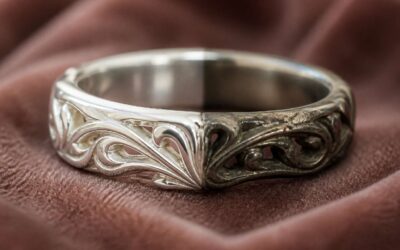
Hammered textures add another layer. They disguise dents and give the ring a handcrafted look that suits both casual and formal attire. Consider how each texture interacts with your routine:
- High polish suits occasional wear but demands frequent buffing.
- Brushed finishes offer resilience for constant use.
- Matte textures develop a soft patina without looking worn.
On a wider band, surface contact increases. Choose a finish that matches your tolerance for upkeep rather than initial shine alone.
Band Width and Thickness Considerations
A silver ring size 8 finger has plenty of surface area for band width to matter. A 2mm band feels flimsy and spins. A 6mm band anchors well. Thickness alters weight. A 1.5mm profile disappears, while 2.5mm adds presence.
Think about your week. Office work favors a slim band. Manual tasks need sturdier metal. The right band should sit between knuckle and palm without pressing. Different widths serve different purposes:
- 2mm to 3mm for office wear.
- 4mm to 5mm for daily balance.
- 6mm plus for bold statements.
Width also changes the fit. A wider ring needs a larger inner diameter, so nominal size 8 often requires a half size up.
Matching Silver Rings to Skin Tone and Lifestyle
Choosing a silver ring size 8 starts with how the metal works with your skin. Cool undertones pop against bright sterling. Warm undertones look better with a brushed finish. Your daily routine matters too. A silver ring size 8 worn by a nurse or builder needs a smooth, low profile. A jeweler or writer can handle more detail.
Consider your week. Do you type, cook, or hike? Each activity changes the ideal band.
– For active hands, pick a solid silver ring size 8 without stones.
– For formal events, a high polish suits your skin.
Match the ring to your personality. A silver ring size 8 on a quiet reader feels calm. On a loud speaker, it adds a glint. The right band does not fight your hand, it settles into your rhythm. That is the real magic of sterling silver.
Shopping for Size 8 Silver Jewelry
Using Printable Ring Sizers Effectively
When you finally decide to order a silver ring size 8 online, the satisfaction of waiting for that package depends entirely on one small piece of paper. Printable ring sizers can fail quietly. A single misaligned printer setting sends your dream ring to the wrong finger.
I always advise shoppers to compare the sizer against a known ruler before cutting. The little scale printed on the strip must match a physical ruler exactly. If it does not, adjust your print scaling. Then wrap the strip around your finger with gentle tension, not slack. The arrow should align with the box labelled 8. A snug, comfortable slip is your goal. This discipline matters deeply for a silver ring size 8, since sterling silver has negligible give.
During this ritual, be mindful of the time of day and room temperature. Fingers swell in afternoon heat and shrink in winter mornings. Measure once, measure twice, and trust the printed scale.
Online Retailers That Offer Accurate Sizing Guides
When shopping online from South African jewellers, the retailer’s sizing guide is your first line of defence. Reputable stores publish measurements in millimetres alongside the size number. Look for guides that explain how to use a ruler against an existing ring, because that method avoids the printer alignment problem. Platforms offer a downloadable chart with a scale bar.
I trust retailers that include photographic comparisons of a ring against a hand, especially for a silver ring size 8. A diagram cannot convey how a ring sits. The best product pages show the guide’s scale bar next to a coin or bank card. Here is what I look for:
- Does the guide list both diameter and circumference?
- Are there photos of the ring on a real hand?
- Do customer reviews mention fit accuracy?
These details save you from the return process once you settle on a silver ring size 8!
Resizing Possibilities: What Works for Silver Rings
Roughly 40% of jewellery buyers never consider resizing before purchase. That is a costly mistake when a silver ring size 8 sits half a size off. Sterling silver is softer than gold, so a jeweller can stretch or compress the shank without destroying the metal. However, not every design tolerates the process.
Here is what affects the outcome:
- Plain bands resize cleanly and hold their shape.
- Engraved bands lose detail when metal is removed.
- Stone settings require rebuilding before any adjustment.
For a silver ring size 8 that runs large, an inset sizing bar or small beads inside the shank solve the problem without changing the outer look. Rings that run small can be stretched only when the band width stays under four millimetres. Wider bands tend to crack under pressure. Ask your jeweller about the shank thickness before you buy.
Seasonal Temperature Changes and How They Affect Fit
Metal expands in heat and contracts in cold. A silver ring size 8 measured during a Johannesburg winter can feel tight by February. Your fingers, much like the metal itself, swell in warmer conditions. This natural fluctuation often reaches half a size or more, which means a comfortable fit on a cool morning might leave a red mark by afternoon. The change is temporary, but it affects daily wear.
Sterling silver transfers temperature quickly. On a hot day, the band warms fast against your skin. In colder months, it can feel shockingly cold at first touch. This thermal conductivity does not alter the size permanently, but it can change how you perceive the fit. A ring that spins in winter may grip firmly in summer, making you second guess the sizing.
– Try on silver rings in the afternoon, when your hands are at their largest.
– Measure in both summer and winter to see the range of your finger size.
– Choose a silver ring size 8 that fits comfortably in warm weather, as loose in winter is easier to manage than tight in summer.
South African weather shifts between extremes, especially in coastal areas like Durban or Cape Town. Humidity plays a role too, causing fingers to retain water. For those between sizes, this seasonal movement matters more. An ideal silver ring size 8 should slide on with slight resistance but never require force to remove.
Pairing Your Size 8 Ring with Other Jewelry
Shopping for a silver ring size 8 in Johannesburg’s lively markets means testing more than just the fit on your finger. You need to consider how the band interacts with the rings beside it. A silver ring size 8 with a thick profile can crowd a delicate band, so bring your everyday pieces to the counter. This habit reveals stacking harmony before you commit.
Pairing your silver ring size 8 with other jewelry asks for balance. Mix textures deliberately, a hammered silver ring next to a smooth wedding band, for instance. Here is a practical guide:
– Match the metal’s finish, matte with matte, polished with polished.
– Keep the total width of stacked rings under 6 mm to preserve comfort.
– Let one piece stand out; a carved silver ring size 8 deserves the spotlight.
These small choices turn a simple band into a signature layer, no guesswork involved.
Caring for Your Silver Ring
Daily Cleaning and Polishing Methods
Tarnish is a chemical fact, not a flaw. A silver ring size 8 reacts with sulphur in the air every day. In South Africa’s humid coastal regions, this process accelerates noticeably. A daily wipe with a soft jewellery cloth removes loose residue before it bonds with the metal.
For deeper cleansing, mix lukewarm water with a few drops of mild dish soap. Dip the ring, scrub gently with a soft brush, then rinse and pat dry. This simple method lifts accumulated oils without scratching the surface.
Keep your ring away from these everyday culprits:
- chlorinated swimming pools
- household bleach sprays
- abrasive metal polishes
Polish once a month using a non-abrasive silver polish. Apply straight strokes, never circles, to avoid micro-scratches. This preserves the ring’s lustre without altering its fit.
Storing Silver Rings to Prevent Tarnish
Storage determines how long a silver ring size 8 retains its glow. Even after a careful polish, the metal remains vulnerable to the very elements that caused the tarnish. In Durban or Cape Town, where sea air carries salt and moisture, a ring left on a bathroom counter will dull within weeks.
- Keep the ring away from rubber bands and latex gloves
- Remove it before applying perfume or hairspray
- Store it apart from other jewellery to avoid scratches
Place the ring in a fabric lined compartment or a small resealable bag. This limits exposure to airborne sulphur. Anti-tarnish strips add an extra layer of protection in humid months.
Professional Maintenance and Inspection
Most people do not think about professional maintenance until a prong fails or the band cracks. By then, the silver ring size 8 may already need resoldering or reshaping. A jeweler’s bench offers more than a simple polish. The magnifying loupe reveals micro-scratches, worn plating, and stress fractures that escape casual observation.
Professional inspection typically covers:
– Prong tension and stone security
– Band thinning from years of wear
– Solder joints along the shank
– Clasp or setting integrity
Ultrasonic cleaning removes trapped debris from engravings and settings, something home methods cannot replicate. In South Africa, many jewellers offer this service while you wait. For a silver ring size 8 worn daily, an annual check is the difference between a minor adjustment and a full restoration.
When to Consider Retiring or Replacing Your Ring
There is a specific quietness to a ring that has absorbed decades of your life. The silver ring size 8 on your finger is not just a measurement of circumference, but a record of your habits. Every knock against a countertop and brush against a handrail has left a trace, and eventually, those traces compromise the integrity of the band.
A ring that spins freely or slips past the knuckle with no resistance has lost its original tension. This is often a sign that the metal has work-hardened to the point of brittleness or simply stretched from daily use. Continuing to wear a loose silver ring size 8 invites risk of loss, but more critically, it indicates the structural bond of the silver is weakening.
– Visible cracks or rough edges catching on clothing
– A permanent misshapen oval worn into the band
– Thinning that you can feel when pressing the shank between two fingers
– Persistent skin irritation from exposed base metal alloys
When the design itself is dated, or you find yourself selecting other rings constantly because yours no longer fits your aesthetic, the utility is gone. The silver ring size 8 has fulfilled its purpose. Keeping a ring that physically cannot be resized any further, or one that has become symbolic of a prior version of yourself, is often a decision based on sentiment rather than practicality. The honest assessment is whether the ring still functions, and whether it still represents you. If the answer is no on both counts, retiring it is not a failure, but a recognition of the ring’s natural life cycle.
0 Comments